Ficoflora Venezuela Project
Marine algae have been an important biological resource for many countries for many decades, which has created the need to improve their taxonomic knowledge in order to contribute to their conservation.
Several studies on the taxonomic and floristic aspects of benthic marine macroalgae have been carried out along the coast of Venezuela. The first collections of algae in Venezuela date back to 1799 and were made by the Germans Alexander von Humboldt and Aimé Bonpland on their arrival in the New World, during expeditions to Cumaná, La Guaira and Puerto Cabello. Most of the phycofloristic studies published in the first six decades of the 20th century were carried out by researchers such as William R. Taylor, Manuel Díaz-Piferrer, Ernesto Foldats and E.K. Ganesan, whose contribution was very valuable and pioneering for the study and knowledge of our phycoflora in this early period.
Particularly noteworthy is the contribution of Venezuelan scientists such as Nora Rodríguez de Ríos, who compiled the list of macroscopic algae of Mochima Bay (Sucre) and several localities in Aragua State, and made an important contribution to the taxonomic study of the genera Laurencia and Gracilaria, describing several species new to science; Andrés Lemus in the Gulf of Cariaco and the Paria Peninsula (Sucre); and Olga Albornoz, who carried out important inventories in the Paraguaná Peninsula (Falcón) and in Los Roques Archipelago National Park over the last 20 years.
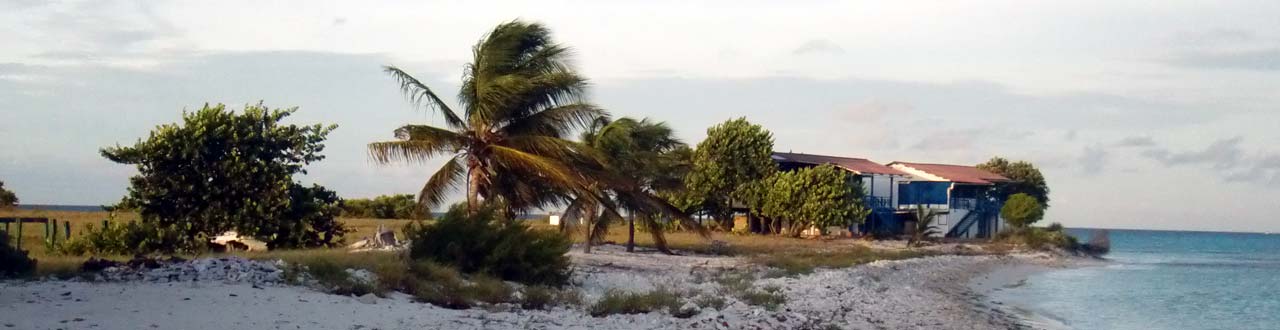
Dos Mosquises Biological Station, Los Roques Archipelago National Park, Miranda Insular Territory, Venezuela. | Santiago Gómez ©
Over the last three decades, several Venezuelan researchers have made valuable contributions to the taxonomy, nomenclature and distribution of new taxa of marine algae of Venezuela, among them:
- Aidé Velázquez (Universidad de Oriente, Nueva Esparta)
- Beatriz Vera (Universidad Central de Venezuela, Distrito Capital)
- Jorge Barrios (Universidad de Oriente, Sucre)
- María A. Solé (Fundación La Salle de Ciencias Naturales, Nueva Esparta)
- Mayra García (Universidad Central de Venezuela, Distrito Capital)
- Mirella Aponte (Universidad de Oriente, Sucre)
- Nelson Gil (Universidad Pedagógica Experimental Libertador, Distrito Capital)
- Santiago Gómez (Universidad Central de Venezuela, Distrito Capital)
- Sonia Ardito (Universidad de Carabobo, Carabobo)
From the above it is clear that we have important floristic and taxonomic information on many regions of the country, but in many cases these data are scattered. The most complete publication has been "A Catalog of Benthic Marine Algae and Seagrasses of Venezuela" (Catálogo Nacional de Algas Bénticas y pastos marinos de Venezuela), published by Ganesan in 1989, which compiles records of about 530 species from the Venezuelan coast. Moreover, much of the published information consists of floristic lists without descriptions, keys, illustrations or maps, which gives this initiative its educational value, since this catalog contains the phycofloristic bibliography from 1822 to the present, together with photographs and georeferenced data.
It is also an opportunity to add other kinds of scientific and/or outreach material that users wish to contribute and that would be very useful for this community. Venezuela has a remarkable diversity of benthic marine macroalgae; however, up-to-date floristic and taxonomic information is lacking for many regions of the country. There are many records of poorly documented or rare species, of uncertain taxonomic identity or restricted geographic distribution, as well as a lack of geographic data on natural populations and their possible use. The activities planned in this project will provide data to improve these aspects.
We invite national and international phycologists to strengthen the Digital Taxonomic Catalog of the Benthic Marine Macroalgae of Venezuela by sending us articles or research not included in this initial edition, as well as reports, photographs, news, events or announcements of national and international activities of interest.
Funding and Institutional Support
This project has been made possible thanks to funding from:
- The Council for Scientific and Humanistic Development of the Universidad Central de Venezuela (CDCH-UCV), through the Group Project PG 03-8643-2013.
- The National Fund for Science, Technology and Innovation (Fonacit) and the Ministry of Science and Technology (FONACIT-MinCyT), through the project "Digital Taxonomic Catalog of the Benthic Marine Macroalgae Phycoflora of Venezuela. Subproject I. Update of species and new reports of the Venezuelan marine phycoflora", No. 2023PGP247.
We also thank the following institutions for their institutional and logistical support:
- Research and Administrative Coordination Offices, Faculty of Sciences, UCV
- Institute of Experimental Biology, IBE, Faculty of Sciences, UCV
- Computer-Assisted Teaching Center, CENEAC, School of Computing, UCV
- Dr. Tobías Lasser Experimental Botanical Garden Institute, UCV
- José Manuel Siso Martínez Miranda Pedagogical Institute, UPEL
- Computing Center, Faculty of Sciences, UCV
- Guayacán Ecological Research Center (CIEG), Universidad de Oriente, Sucre Campus
- We would also like to thank Prof. Evelyn Zoppi de Roa † (UCV), Mr. Abel Vásquez and Mr. Francis Lemus (boatmen) for their collaboration.







Credits :: Research and Development Team of the Digital Catalog
Taxonomy of Tropical Marine Algae.
Instituto de Biología Experimental
IBE - UCV
/ Biologist, Coordinator
Universidad Central de Venezuela
chachacho@gmail.com
Software Application Development and Database Design.
School of Computing
CENEAC - UCV
/ Computer Scientist
Universidad Central de Venezuela
yusneyicarballo@gmail.com
Taxonomy of Tropical Marine Algae.
Fundación Instituto Botánico de Venezuela
FIBV - UCV
/ Biologist
Universidad Central de Venezuela
mayra.garcia@ucv.ve
Taxonomy of Tropical Marine Algae.
Instituto Pedagógico de Miranda
IPM JMSM - UPEL
/ Biologist
Universidad Pedagógica Exp. Libertador
21-06-1965 | 05-04-2020

Thesis student who developed the Data Management, Statistics and Search modules.
School of Computing - UCV
/ Computer Scientist
Universidad Central de Venezuela
BEST UNDERGRADUATE THESIS Award SCTC 2016
mjpinzon@gmail.com
Tools and technologies
Ficoflora Venezuela has been developed combining several technologies:
- HTML5, CSS, JavaScript, jQuery, Bootstrap, Laravel APIs, PHP, MySQL and XAMPP Apache Web Server for the development of the modules, features and the species profile
- C3js, as a library for data conversion and statistical charts
- Leaflet and OpenStreetMaps, for interactive maps and georeferencing
- Adaptive Software Development (ASD) methodology
- mPDF, to create and export the species profile as a portable document (.pdf)